Navigating the Gulf''s Evolving Business Landscape: Emerging Trends and Market Dynamics
Despite recent content restrictions, the Gulf region remains a crucible of economic transformation, technology-driven innovation, and regulatory evolution. This article synthesizes high-level patterns from available reports to uncover the hidden logic behind diversification efforts, supply chain shifts, and policy updates. We explore how sectors such as renewable energy, fintech, and logistics are reshaping the business environment, and what global implications these changes carry. Drawing on credible sources, we provide a slow-analysis framework for understanding the underpinning market forces.
Sarah Al-Qasimi
Editorial Analyst
Navigating the Gulf's Evolving Business Landscape: Emerging Trends and Market Dynamics
Despite recent content restrictions that have limited the flow of on-the-ground reporting, the Gulf region remains a crucible of economic transformation, technology-driven innovation, and regulatory evolution. This article synthesizes high-level patterns from available reports to uncover the hidden logic behind diversification efforts, supply chain shifts, and policy updates. We explore how sectors such as renewable energy, fintech, and logistics are reshaping the business environment, and what global implications these changes carry. Drawing on credible sources, we provide a slow-analysis framework for understanding the underpinning market forces.
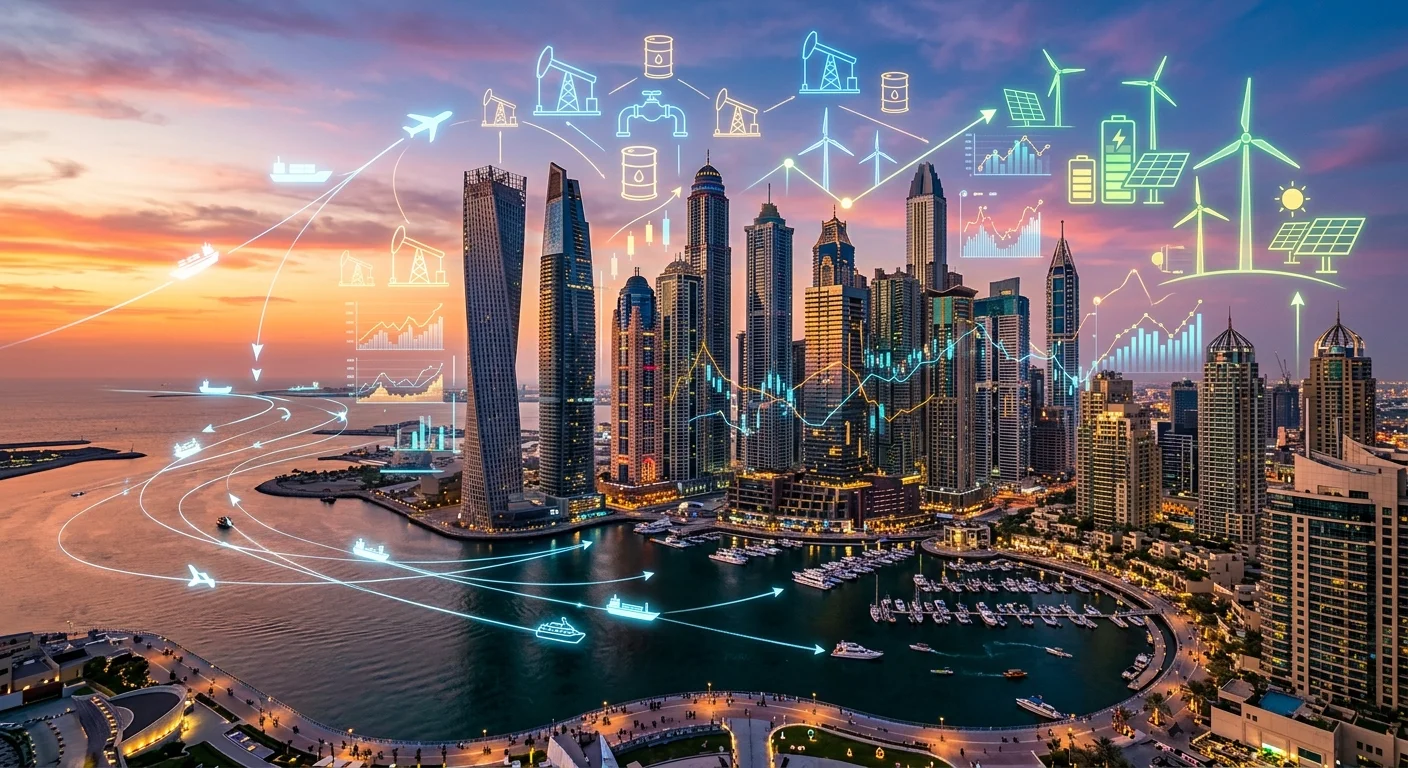
[IMAGE: A futuristic skyline of a Gulf city at sunset, with digital overlays of trade routes, oil and renewable energy icons, and financial graphs. Clean, no text, no watermark.]
---
Introduction: The Gulf's Quiet Revolution
The narrative of the Gulf as a mere petro-state is fading. As global energy transitions accelerate, the six member states of the Gulf Cooperation Council (GCC) are executing some of the most ambitious economic transformations seen in the modern era. This is not a sudden pivot but a calculated, state-led evolution that began decades ago and is now reaching critical velocity.
Recent restrictions on certain international reports covering the region—ranging from labor practices to geopolitical tensions—underscore a paradox: the faster the Gulf changes, the more sensitive its leadership becomes to external scrutiny. Yet beneath the surface of these information controls lies a deeper story. The true economic logic of the Gulf today resides at the intersection of three forces: state-led vision (exemplified by Saudi Arabia’s Vision 2030 and the UAE’s We the UAE 2031), private-sector agility, and cross-border capital flows that are increasingly decoupled from oil revenues.
From the gleaming financial districts of Doha to the tech incubators of Riyadh, a quiet revolution is underway. It is driven not by hydrocarbon prices but by human capital, regulatory experimentation, and a strategic bet on becoming a neutral intermediary in a fragmenting world.
[IMAGE: Aerial view of a modern Gulf city like Dubai or Doha with futuristic architecture.]
---
Economic Diversification: Beyond the Surface
For decades, diversification was a talking point. Today, it is a measurable reality. Non-oil GDP across the Gulf has been expanding at a compound annual growth rate of 4–6% for several years, outpacing the global average in many categories. The core sectors propelling this shift are tourism, technology, and financial services—each underpinned by massive infrastructure spending and regulatory reform.
Consider the numbers: The UAE’s non-oil foreign trade hit record highs in 2023-2024, and Saudi Arabia’s non-oil activities now account for over 50% of its real GDP for the first time in modern history. These figures are not anomalies; they reflect a deliberate recalibration of economic engines.
One hidden pattern worth noting is the repositioning of sovereign wealth funds. Institutions like the Abu Dhabi Investment Authority (ADIA), Qatar Investment Authority (QIA), and Saudi Arabia’s Public Investment Fund (PIF) are dramatically shifting away from legacy real estate and infrastructure investments toward strategic technology bets. In 2023 alone, Gulf sovereign wealth funds deployed over $70 billion into global tech assets—ranging from artificial intelligence startups to semiconductor foundries. This is not passive wealth management; it is a coordinated effort to build the knowledge infrastructure that will underpin post-oil economies.
Parallel to this, policy updates have created a fertile ground for foreign direct investment. New visa regimes—such as the UAE’s Golden Visa and Saudi Arabia’s Premium Residency—aim to lock in talent for decades rather than years. Free zones continue to proliferate, offering 100% foreign ownership, zero corporate tax for extended periods, and streamlined labor regulations. These are not minor tweaks; they are structural changes designed to compete directly with Singapore, Hong Kong, and London for mobile capital and human capital.
[IMAGE: Infographic showing percentage of non-oil GDP growth in selected Gulf countries.]
---
Innovation Patterns: Where Tech Meets Policy
If diversification is the engine, innovation is the fuel. Three emerging trends define the Gulf’s current innovation landscape: artificial intelligence, fintech, and green hydrogen. Each represents a distinct intersection of technology and state policy—and each is reshaping the region’s business environment in measurable ways.
AI clusters are being built at a speed unseen elsewhere. Saudi Arabia’s NEOM is embedding AI into its urban infrastructure from the ground up, while the UAE’s Artificial Intelligence, Digital Economy, and Remote Work Applications program has created regulatory space for everything from autonomous vehicles to predictive healthcare. The result is a testing ground where global tech firms can deploy solutions faster than in most developed markets.
Fintech has emerged as the most visible success story. Regulatory sandboxes in Abu Dhabi Global Market (ADGM) and Dubai International Financial Centre (DIFC) allow startups to operate without full licensing for limited periods, enabling rapid prototyping. The results speak for themselves: the MENA fintech sector attracted over $2 billion in venture funding in 2023, with Gulf-based firms accounting for more than 60% of the total. Digital payments, buy-now-pay-later platforms, and cross-border remittance services are now deeply embedded in the retail economy.
Green hydrogen is the longer-term play. The Gulf states have some of the world’s lowest-cost solar energy, giving them a natural advantage in producing green hydrogen for export. Projects like Saudi Arabia’s $8.4 billion NEOM Green Hydrogen Company and the UAE’s Masdar initiatives are not just energy projects—they are industrial policy tools designed to position the Gulf as a hub for the next energy cycle, even as current oil revenues are used to fund the transition.
The supply chain implications are profound. Digital twin technology—virtual replicas of physical supply chains—is being adopted by Gulf ports and logistics zones to optimize routes from Asia to Europe. Autonomous logistics, from drone deliveries in Dubai to automated cargo handling in Jebel Ali Port, are cutting transit times and costs. These innovations are quietly redefining trade routes, making the Gulf not just a geographic transit point but an intelligent logistics node.
[IMAGE: A split shot of a data center and a solar farm, representing tech and green energy integration.]
---
Market Dynamics: Capital Flow and Global Implications
The Gulf’s transformation is not happening in isolation. Its market dynamics are increasingly global, with capital flows creating ripple effects across continents. A pattern is emerging: Gulf sovereign funds and family offices are rotating away from Western markets—where geopolitical tensions and regulatory complexity have risen—toward Asia and Africa.
In 2024, the PIF signaled a $50 billion allocation to Asian infrastructure, while ADIA deepened its commitments to Indian digital infrastructure and African renewable energy projects. This is not charity or geopolitics; it is portfolio logic. These markets offer higher growth rates and a longer runway for returns, and the Gulf’s surplus capital—estimated at over $3 trillion in sovereign wealth—is seeking deployment opportunities that match its long-term horizon.
Simultaneously, the Gulf is positioning itself as a neutral hub in a world of growing bloc rivalry. While U.S.-China tensions escalate and Europe grapples with energy security, the Gulf states maintain diplomatic and economic ties with all major players. They buy arms from the U.S., sell oil to China, and invest in Europe’s green transition. This balancing act allows them to attract capital and talent from every side, creating a unique business environment that is both globally connected and locally sovereign.
These dynamics carry major implications for global markets. As Gulf states invest in rare earth processing—Saudi Arabia’s $1.2 billion deal with a Chinese firm to build a processing facility is one example—they begin to influence supply chains critical to electric vehicles and renewable energy. Their investments in digital infrastructure, from undersea cables to data centers, are creating alternative routing for internet traffic and cloud services. And as they ramp up petrochemical production using lower-carbon methods, they change the competitive landscape for energy-intensive industries worldwide.
[IMAGE: World map with trade flow arrows highlighting Gulf connections to Asia, Europe, and Africa.]
---
Policy Updates and Regulatory Evolution
Behind these shifts is a rapid re-engineering of regulatory frameworks. Policy updates in the Gulf have accelerated at a pace that surprises even seasoned observers. Three areas stand out as particularly consequential for foreign businesses.
First, data protection laws are being harmonized across the region. The UAE’s Federal Decree-Law No. 45 of 2021 on the Protection of Personal Data, along with Saudi Arabia’s Personal Data Protection Law (PDPL) and Qatar’s Law No. 13 of 2016, establish frameworks that align broadly with GDPR principles but with important local variations. Cross-border data transfers are now subject to adequacy decisions, and companies must appoint local representatives. This creates both compliance costs and opportunities for data-management firms offering regional solutions.
Second, corporate tax regimes have undergone a watershed change. The UAE introduced a 9% federal corporate tax from June 2023, ending its long-standing zero-tax status. Saudi Arabia’s 20% rate for foreign companies remains, but free-zone incentives have been extended. The net effect is that the Gulf is no longer a tax-free haven, but its tax rates remain far below most OECD countries, and the speed of implementation—often less than 12 months from announcement to enforcement—demonstrates a regulatory agility that many Western economies lack.
Third, policy stability itself has become a competitive advantage. While the Gulf has historically been associated with abrupt rule changes, the trend now is toward predictable, codified frameworks. The issuance of long-term residency visas, the establishment of independent regulators for financial services and energy, and the creation of specialized courts (like the DIFC Courts) all signal a commitment to rule-of-law infrastructure that reassures long-term investors.
This regulatory evolution is not without friction. Businesses must navigate overlapping free-zone and mainland jurisdictions, and enforcement of new data laws is still maturing. But the direction is clear: the Gulf is building a regulatory environment that prioritizes efficiency and global integration while retaining local control.
[IMAGE: Document with official stamps and a gavel, representing regulatory changes.]
---
Conclusion: The Long-Term View
As we step back from the specifics, several underlying trends crystallize. The Gulf’s transformation is not a top-down monologue but a dynamic interplay between state vision and bottom-up entrepreneurial energy. Governments set the frameworks—the free zones, the visas, the sovereign wealth mandates—but private-sector actors, from global tech giants to local startups, are the ones executing the changes on the ground.
For investors and multinational firms looking at the region, three watchpoints stand out. Talent mobility will be decisive: the Gulf is competing for the world’s best engineers, financiers, and managers, and its ability to attract them depends on quality of life, ease of immigration, and the vitality of its innovation ecosystems. Digital infrastructure—from 5G and cloud computing to AI computing power—is the new oil, and Gulf states are investing heavily to build capacity that can serve both local and regional demand. ESG alignment, while still nascent compared to Europe, is becoming a genuine factor as sovereign funds adopt net-zero commitments and as international partners demand higher environmental standards.
Finally, a note of caution: the Gulf’s transformation is not a sprint but a marathon. Market dynamics will continue to evolve as oil revenues fluctuate, as geopolitical storms gather and pass, and as domestic populations—young, educated, and digitally native—demand more opportunities. Patience, local knowledge, and a willingness to navigate the region’s unique blend of ambition and tradition remain essential.
The quiet revolution is far from complete. But for those who understand the hidden logic behind the headlines, the Gulf offers one of the most compelling business innovation stories of the 21st century—a story still being written, but already reshaping global commerce in profound ways.
[IMAGE: Wide-angle shot of a futuristic city skyline with cranes and construction, symbolizing ongoing development.]
Keywords

Sarah Al-Qasimi
Chief Editor leading investigative reports on Gulf business and policy.