The Double-Edged Sword of Emerging Tech: Boosting Business Performance While Navigating Security and Privacy Risks
Emerging technologies like AR, AI, IoT, and blockchain are driving dramatic gains in customer engagement, operational efficiency, and supply chain optimization—retailers using AR since 2020 report a 90% boost in conversions. Yet the same digital transformation exposes businesses to record-breaking cybersecurity breaches (Microsoft Exchange, First American) and complex privacy regulations. This article explores the hidden economic logic behind innovation adoption, the trade-offs between performance and risk, and how synthetic data and data clean rooms offer a path forward. We analyze real-world case studies, market trends, and strategic insights for leaders balancing growth with resilience.
Layla Ibrahim
Editorial Analyst
The Double-Edged Sword of Emerging Tech: Boosting Business Performance While Navigating Security and Privacy Risks
Introduction: The Innovation–Risk Paradox
Emerging technologies—augmented reality (AR), artificial intelligence (AI), the Internet of Things (IoT), and blockchain—are rewriting the rules of business competition. Retailers that have adopted AR since 2020 report a staggering 90% boost in conversions among shoppers who interact with virtual try-ons or room-viewing tools. AI chatbots slash customer service response times from hours to seconds. IoT sensors enable factories to predict equipment failures before they happen. The promise is undeniable: unprecedented gains in customer engagement, operational efficiency, and supply chain optimization.
Yet every innovation introduces new vulnerabilities. The same digital infrastructure that powers immersive experiences also creates entry points for cybercriminals. The same data lakes that fuel AI models become treasure troves for breaches. The same connectivity that enables real-time inventory tracking exposes supply chains to ransomware attacks. Consider the Microsoft Exchange breach of 2021, which compromised hundreds of thousands of organizations globally, or the First American Financial data leak that exposed 885 million sensitive records. These are not isolated incidents—they are the logical consequence of accelerated digital transformation without commensurate security investment.
This article explores the hidden economic logic driving innovation adoption, the trade-offs between performance and risk, and how emerging tools like synthetic data and data clean rooms offer a path forward. We analyze real-world case studies, market trends, and strategic insights for leaders who must balance growth with resilience.
[IMAGE: Split visual: left side shows a consumer using AR on a smartphone in a store, right side shows a hacker silhouette and code on screen.]
---
The Customer Experience Revolution: AR, VR, and AI Chatbots
Augmented and virtual reality are no longer novelty gimmicks—they are revenue engines. Retailers integrating AR into their shopping experiences have seen conversion rates nearly double. Adidas’ virtual try-on tool for sneakers allows customers to see how a shoe looks on their feet before purchasing, reducing return rates by nearly 30%. Wayfair’s “View in Room” feature uses AR to place furniture in a buyer’s actual living space, dramatically lowering purchase hesitation. The underlying economic logic is straightforward: immersive experiences reduce perceived risk and increase buyer confidence, creating a premium for early adopters.
AI-powered chatbots represent another front. Disney, for example, has employed AI-driven engineering to create interactive characters and customer service agents that respond to guests in real time. Lowe’s LoweBot navigates store aisles to help customers find products, answering questions and even checking inventory. These systems deliver instant, personalized service at scale, cutting friction from the customer journey. The business case is clear: companies that deploy conversational AI see average cost savings of $0.70 per interaction and a 25% reduction in support tickets.
Yet the data that powers these experiences is a double-edged sword. Every AR session captures the user’s environment, body measurements, and behavioral patterns. Every chatbot conversation logs personal preferences, sometimes including sensitive information like payment details or health concerns. This data becomes a liability the moment it is stored, processed, or shared—especially when aggregated across millions of users.
[IMAGE: Split screen: left side shows a person using AR to try on sneakers; right side shows a chatbot interface with a smiling avatar.]
---
Operational Backbone: AI, IoT, and Blockchain in Supply Chains
Behind the customer-facing innovations lies a deeper transformation in operations. According to a McKinsey survey, 43% of merchants plan to integrate AI and machine learning into supply chain planning within the next two years. Use cases include demand forecasting that adjusts to real-time market shifts, self-driving last-mile delivery vehicles, and warehouse robots that pick and pack with human-like dexterity. The payoff is significant: companies using AI-driven supply chain optimization report inventory reductions of 20–50% and service-level improvements of 10–20%.
IoT sensors form the nervous system of this transformation. Temperature sensors in cold chains send alerts the moment a refrigerator fails. Vibration sensors on conveyor belts predict bearing wear before a breakdown stops production. RFID tags track every pallet from factory floor to retail shelf. This real-time data enables proactive decision-making—a shift from reactive to predictive operations that saves millions in downtime and spoilage.
Blockchain adds a layer of trust. By creating tamper-proof, immutable records of each transaction and product movement, blockchain reduces fraud and simplifies audits. For industries like pharmaceuticals and luxury goods, where counterfeiting is rampant, blockchain authentication has become a competitive differentiator.
However, every IoT sensor is a potential entry point for attackers. Every blockchain node requires cryptographic key management that can be compromised. The more digitized the supply chain, the larger the attack surface. Recent attacks on Colonial Pipeline and JBS Foods demonstrated that a single ransomware incident can halt an entire nation’s fuel supply or meat production. The hidden economic pattern is clear: the shift from reactive to predictive operations comes with an expanded vulnerability perimeter.
[IMAGE: Infographic of a connected supply chain: trucks with IoT sensors, warehouse robots, blockchain nodes, and data flows; with red warning icons on sensor connection points.]
---
The Dark Side: Cybersecurity Breaches and Data Exposure
The same digital transformation that boosts performance also exposes businesses to record-breaking cybersecurity breaches. The Microsoft Exchange hack in 2021 exploited four zero-day vulnerabilities, allowing attackers to access email servers and deploy ransomware across tens of thousands of organizations. The damage—both direct ransom payments and the cost of remediation—exceeded $1.8 billion. The First American Financial leak was not a sophisticated hack but a simple web application vulnerability called Insecure Direct Object Reference (IDOR), which allowed anyone with a URL to access mortgage documents containing Social Security numbers, bank account details, and tax records. The lesson: even basic security hygiene failures can expose millions of records.
For retailers and e-commerce platforms, the stakes are especially high. A data breach not only triggers regulatory fines but also erodes customer trust—a cost that is difficult to quantify but often more damaging in the long run. The average cost of a data breach reached $4.45 million in 2023, according to IBM’s Cost of a Data Breach report. For companies in highly regulated sectors like healthcare or finance, that figure can double.
The root cause is often a misalignment between innovation speed and security investment. Sales and product teams push for faster deployment of AI chatbots or AR features. Security teams struggle to keep up with code reviews, vulnerability scans, and compliance checks. The result is technical debt: systems built quickly with minimal security considerations, later patched reactively when a breach occurs.
[IMAGE: Dark digital silhouettes of hacked servers, red padlock icons broken, and a chain of data nodes splitting apart; background shows a glowing network map.]
---
The Regulatory Maze: Privacy Laws and Compliance Challenges
Data privacy regulations have evolved rapidly in response to public concern. The European Union’s General Data Protection Regulation (GDPR) set a global benchmark, imposing fines of up to 4% of annual global revenue for non-compliance. California’s Consumer Privacy Act (CCPA) and its successor, the CPRA, followed suit. Brazil’s LGPD, India’s DPDP Act, and dozens of other national laws now create a patchwork of requirements that multinational businesses must navigate.
For companies using AI and IoT, compliance is particularly complex. GDPR requires explicit consent for data collection and imposes strict limits on automated decision-making. But an AR application that scans a user’s face to try on glasses collects biometric data—a category that receives special protection under both GDPR and CCPA. An IoT sensor tracking employee movement in a warehouse may violate workplace privacy laws in some jurisdictions. The legal risk multiplies when data crosses borders, as the recently invalidated EU-US Privacy Shield agreement demonstrated.
The operational burden is heavy. Companies must maintain detailed records of data processing activities, respond to consumer requests (access, deletion, portability) within tight deadlines, and conduct Data Protection Impact Assessments for high-risk use cases. Failure to do so can result in fines, class-action lawsuits, and reputational damage.
[IMAGE: Map of the world with highlighted regions (EU, California, Brazil, India) and privacy regulation acronyms; arrows show cross-border data flows with warning signs.]
---
Strategic Solutions: Synthetic Data and Data Clean Rooms
How can businesses capture the benefits of emerging technologies without falling prey to breaches or regulatory fallout? Two approaches are gaining traction: synthetic data and data clean rooms.
Synthetic data is artificially generated information that mimics the statistical properties of real data without containing any actual personal information. AI models can be trained on synthetic data for tasks like fraud detection, demand forecasting, or image recognition without ever exposing real customer records. For example, a retailer can generate synthetic transaction records that replicate purchase patterns, seasonal trends, and product affinities—then use that data to train a recommendation engine. The model performs just as well, but the company never stores or processes real customer data, dramatically reducing breach risk and regulatory burden.
Gartner predicts that by 2030, synthetic data will completely overshadow real data in AI model training. Already, companies in healthcare and finance are adopting synthetic datasets to accelerate research while staying compliant with HIPAA and GDPR. The economic logic is compelling: synthetic data eliminates the trade-off between data utility and privacy.
Data clean rooms offer another solution. These are secure environments where multiple parties can share and analyze data without exposing raw information. For example, an advertiser and a retailer can run joint analytics to measure campaign effectiveness—matching customer IDs and purchase data—but the clean room ensures that neither party sees the other’s underlying data. Only aggregated, anonymized insights are output.
This is particularly valuable for supply chain partnerships. A manufacturer and a logistics provider can share IoT sensor data in a clean room to optimize routing and inventory, without revealing proprietary production schedules or customer lists. Zero Trust Architecture (ZTA) complements these tools by enforcing strict identity verification for every device and user, assuming that no network is inherently safe. Together, synthetic data, data clean rooms, and ZTA form a layered defense that allows innovation to proceed without sacrificing security.
[IMAGE: A diagram showing two datasets entering a ‘Data Clean Room’ (secure box) and outputting only aggregated insights; an arrow labeled ‘Synthetic Data Generator’ on the side converting raw data into artificial data that bypasses privacy risks.]
---
Conclusion: Balancing Growth and Resilience
The double-edged sword of emerging tech is not a paradox to be resolved—it is a tension to be managed. Companies that avoid innovation altogether will fall behind competitors who capture the 90% conversion lift from AR or the 43% supply chain efficiency gain from AI. But those that rush headlong into digital transformation without investing in security and privacy will face breaches that erase those gains and more.
The most successful organizations are adopting a risk-intelligent approach: they evaluate each emerging technology’s potential performance boost alongside its specific security and privacy implications before deployment. They invest in preventive measures like Zero Trust Architecture, proactive tools like synthetic data, and collaborative frameworks like data clean rooms. They treat compliance not as a checkbox but as a strategic capability.
As the regulatory landscape continues to tighten and cyber threats grow more sophisticated, the ability to navigate this tension will become a core competitive advantage. The question is no longer whether to adopt emerging technologies—but how to adopt them wisely.
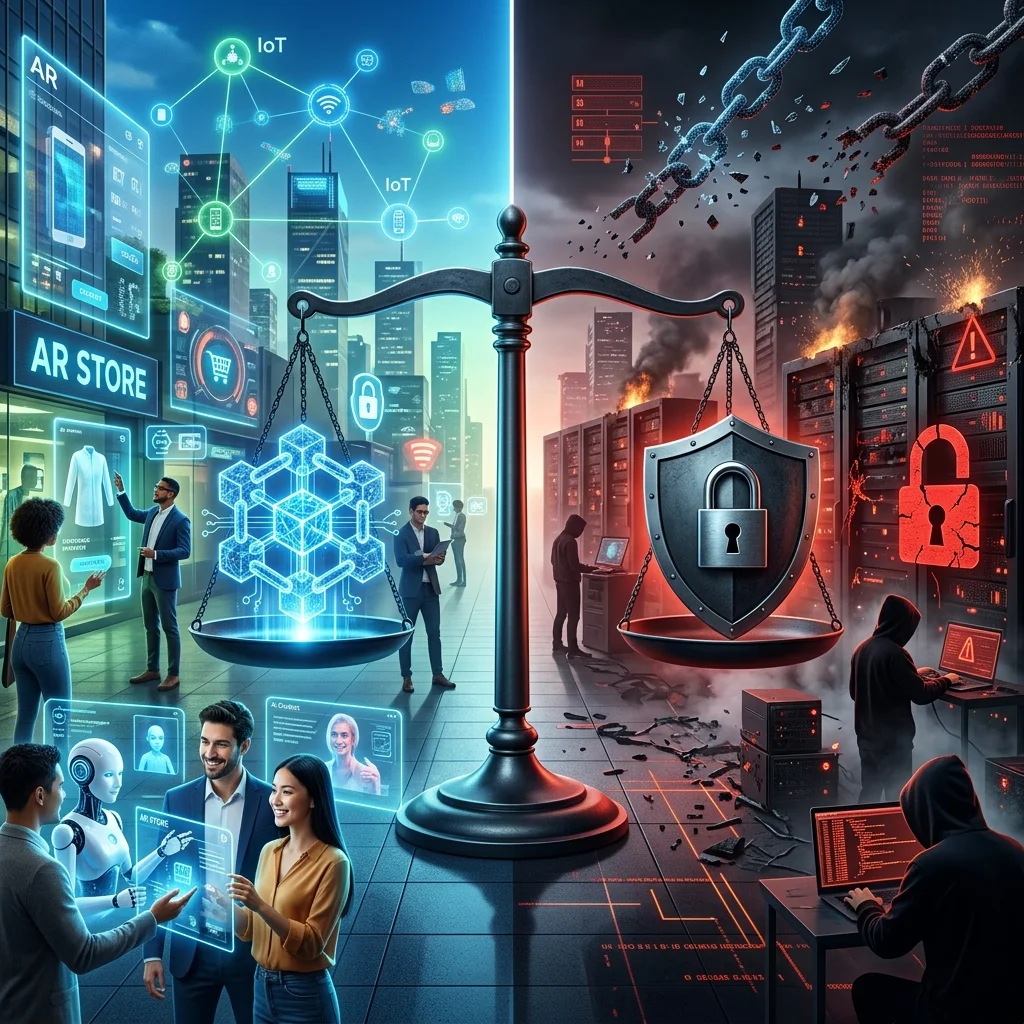
[IMAGE: A balanced scale with a glowing blockchain icon on one side and a shield with a lock on the other side; background shows a futuristic cityscape with both bright AR overlays and dark digital shadows.]
Keywords

Layla Ibrahim
Technology Reporter covering fintech, AI, and startup ecosystems in the Gulf.